
Buying guide
Types of hospital gowns explained
Quick answer: hospital gowns come in eight main types: standard tie-back, IV or telemetry, bariatric, exam, surgical, isolation, pediatric and maternity. They are usually made of a 55/45 cotton-polyester blend, open at the back for access, and are also called patient gowns or johnny gowns. This guide explains each type, what it is made of and which one a facility should stock.
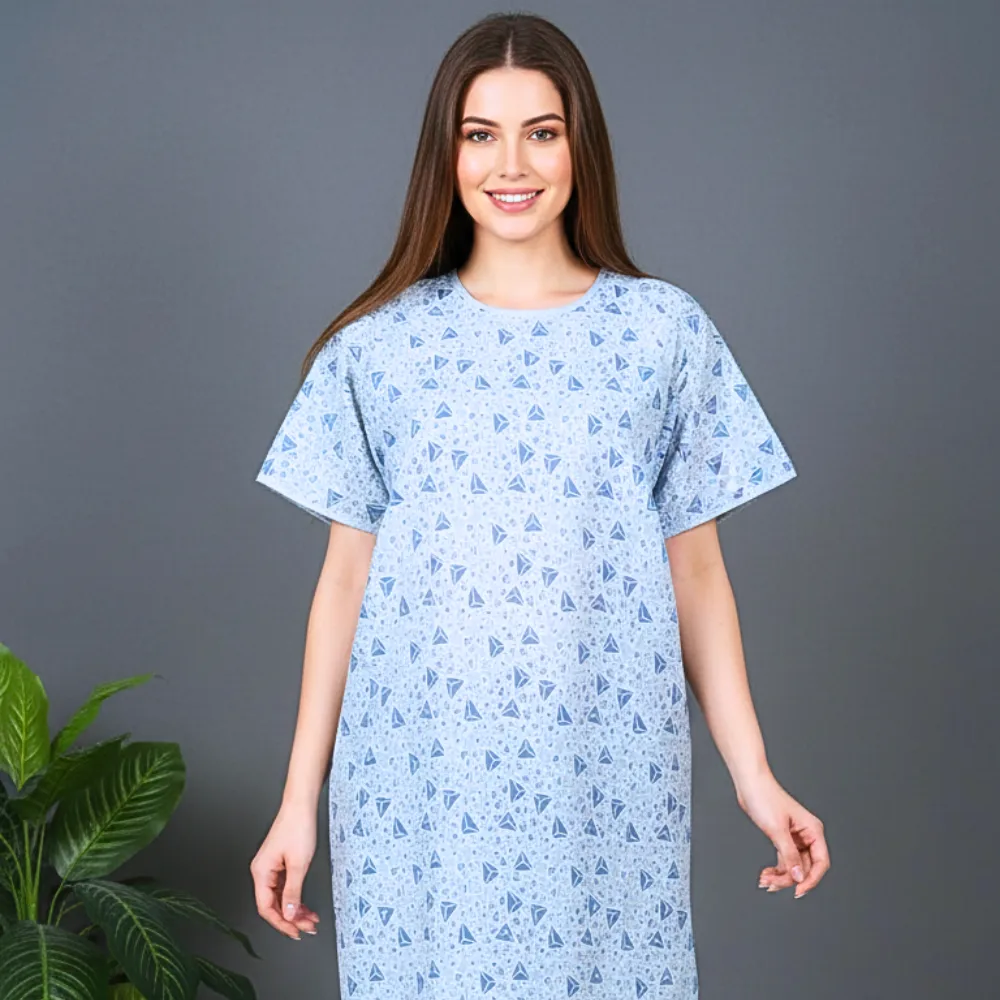
International Linens cuts and stitches reusable patient gowns for hospital groups and healthcare distributors, so this guide is written from the pattern table rather than from a catalogue. Where a type has a common alternative name, both are given.
What is a hospital gown called?
The formal name is a patient gown or medical gown. In North America nurses often call it a johnny gown or simply a johnny, a term that dates from early twentieth-century hospital slang. Purchasing departments say patient apparel, which also covers pajamas and pants. Whatever the name, the garment is the same: a loose, open-back gown that gives clinicians access to the body and can be changed on a patient who cannot stand.
Types of hospital gowns
| Type | What it is | Where it is used |
|---|---|---|
| Standard tie-back gown | Back-opening gown with neck and waist ties, three-quarter sleeves, one-size-fits-most | General wards, admissions, outpatient |
| IV gown | Sleeves open along the top with snaps so an IV line does not have to be disconnected to change the gown | Medical and surgical wards, oncology, anywhere patients have lines |
| Telemetry gown | IV-style snap sleeves plus a chest pocket for a cardiac telemetry transmitter | Cardiac, step-down and monitored units |
| Bariatric gown | Full-coverage gown graded to 3XL, 5XL and 10XL with longer ties and wider wrap | Bariatric programs, larger patients on any ward |
| Lapover / double lapover gown | Back panels overlap instead of tying, so the patient stays covered when walking or in a wheelchair | Rehabilitation, transport, dignity programs |
| Exam and mammogram gown | Short, front-opening or cape-style gown | Imaging, outpatient clinics, physical exams |
| Surgical gown | Sterile-process gown worn by the surgical team, not the patient; barrier fabric, back closure, knit cuffs | Operating theatres |
| Isolation gown | Reusable or disposable protective gown worn by staff and visitors over clothing | Infection-control precautions |
| Behavioral health gown | Tear-resistant fabric, adjustable straps, no removable ties or drawstrings | Mental health and secure units |
| Pediatric gown | Child, toddler and infant sizes, usually printed, with snap or tie closures | Children’s hospitals and pediatric wards |
| Maternity / labour gown | Wider wrap, front and shoulder snaps for monitoring and feeding | Maternity units |
| Hyperbaric gown | 100% cotton with no synthetic fibre or metal | Hyperbaric oxygen chambers |
What are hospital gowns made of?
Reusable hospital gowns are almost always a cotton-polyester blend, most often 55% cotton and 45% polyester. Cotton gives softness and breathability; polyester gives strength, fast drying and colour retention through hundreds of hot washes with bleach. Some programs specify 100% cotton for sensitive skin or hyperbaric use, and 100% polyester where print durability and quick drying matter most. Disposable gowns are spun-bonded polypropylene and are worn once. The fabric weight for a reusable gown is typically 4 to 5 ounces per square yard, light enough to be comfortable and heavy enough not to be transparent. At our units the fabric is woven and finished in-house under OEKO-TEX Standard 100 Class I certified processing, then cut and stitched to the buyer’s pattern.
Front-opening or back-opening?
Standard hospital gowns open at the back so clinicians can reach the spine, apply monitors and change the gown on a bed-bound patient. The trade-off is modesty, which is why lapover and double lapover designs exist: the back panels overlap by 20 inches or more, so the patient is covered while walking. Exam and mammogram gowns open at the front because the clinician needs the chest, and maternity gowns use front snaps for the same reason. When a facility asks for “gowns that open in the front”, the answer is usually an exam gown or a front-snap lapover gown, not a standard ward gown worn backwards.
Sizing
Most ward gowns are cut one-size-fits-most, with a chest of about 50 to 54 inches and a length of 40 to 45 inches, which covers most adults. Bariatric gowns are graded separately to 3XL, 5XL and 10XL with chest measurements up to about 100 inches and longer ties. Pediatric gowns run infant, toddler and child small to large. A facility that stocks one-size, one bariatric size and a pediatric range covers almost every patient.
Closures and fittings
- Ties: the classic neck and waist tie, cheapest to make and easiest to launder.
- Snaps: rust-proof metal or plastic snaps on sleeves and shoulders for IV, telemetry and maternity gowns; they must survive tunnel washers and ironers.
- Overlap: lapover backs that need no fastening at all.
- Adjustable straps and sewn-in ties: used on behavioral health gowns so nothing can be removed.
Colours and prints
There is no universal colour code for patient gowns. Blue and green are the most common because they hide bleach marks and look clinical, prints are used for pediatrics and to soften the ward environment, and some hospitals assign colours to departments or patient groups. Our separate guide on hospital gown colour meaning covers the conventions in detail.
Reusable or disposable?
A reusable gown is laundered and worn 50 to 100 times; a disposable gown is worn once. For a hospital with in-house or contract laundry, reusable gowns cost less per wear and produce a fraction of the waste, and they feel better to the patient. Disposables still make sense for isolation precautions where the garment must be discarded, and for facilities without laundry access.
Choosing gowns for your facility
Start with the patient population. A general hospital needs standard tie-back gowns as the bulk item, IV or telemetry gowns for monitored units, a bariatric size and a pediatric range if it has children’s beds. A surgical centre needs exam gowns and standard gowns. Long-term care leans towards lapover gowns and two-piece patient pajamas. Then set fabric, colour and closure once for the whole program so every gown launders the same way. International Linens makes all of the types above; see the patient gowns page for specifications and the patient apparel collection for pajamas, lab coats and isolation gowns.
In the United States, patient gowns are clothing textiles under the 16 CFR Part 1610 flammability standard.
Frequently asked questions
What are the different types of hospital gowns?
Standard tie-back, IV and telemetry, bariatric, lapover, exam and mammogram, surgical, isolation, behavioral health, pediatric, maternity and hyperbaric gowns. Each is described in the table above.
What are hospital gowns made of?
Reusable gowns are usually a 55/45 cotton-polyester blend; some are 100% cotton or 100% polyester. Disposable gowns are polypropylene.
What is a hospital gown called?
Patient gown or medical gown officially; johnny gown informally in North America.
Do hospital gowns open in the front or the back?
Ward gowns open at the back for clinical access. Exam, mammogram and maternity gowns open at the front. Lapover gowns overlap at the back for modesty.
What is an IV gown?
A gown whose sleeves open along the top with snaps, so it can be changed without disconnecting an intravenous line.
What size is a standard hospital gown?
One-size-fits-most, roughly a 50 to 54 inch chest and 40 to 45 inch length. Bariatric gowns go to 10XL.
Can hospital gowns be washed with bleach?
Reusable cotton-polyester gowns are designed for hot washing with bleach; colour-fast dyes and rust-proof snaps are specified for that reason.